


Why I Believe Boxing Is One of the Best Sports You Can Learn

Updated: Aug 22

How preparing for a bodybuilding competition unexpectedly introduced me to a sport that completely changed the way I train, move and coach.
How Bodybuilding Led Me to Boxing
My journey into boxing actually started because of bodybuilding.
In 2016, I was preparing for Mr. Olympia Amateur Asia, my first physique competition. The goal was simple: get extremely lean while preserving as much muscle as possible.
Instead of continuously cutting food lower and lower, I wanted another way to increase my energy expenditure.
So I started boxing.
At the beginning, I honestly saw it as cardio.
Hit the pads. Hit the bag. Sweat. Burn calories. Go home.
That was basically it.
But the more I trained, the more I realised boxing was exposing weaknesses that years of bodybuilding had never shown me.
I had built plenty of muscle.
But I didn't really know how to use my body as one connected system.
And my boxing coach made that very clear.

"You're Punching Like a Robot"
I still remember being told this.
"You're punching like a robot."
And he was right.
For years, bodybuilding had taught me to isolate muscles.
Chest day.
Back day.
Shoulders.
Arms.
Legs.
That approach had been incredibly effective for building my physique. It taught me discipline, progressive overload and how to develop muscle.
But then someone asked me to throw a punch properly.
Suddenly, having big shoulders and arms didn't mean very much.
I was trying to generate everything from my upper body. My punches were stiff, I wasted energy and I fatigued incredibly quickly.
Boxing forced me to think differently.
A good punch doesn't begin with your fist.
It involves the ground, feet, legs, hips, trunk, shoulder and arm working together.
For the first time in years, I stopped thinking about individual muscles.
I started thinking about movement.

Learning to Use the Whole Body
This is one reason boxing fascinated me so much.
Something as simple as throwing a cross is actually a highly coordinated movement.
You're transferring force from the ground, rotating through the lower body and trunk, and delivering that force through the upper body while maintaining balance.
Research into boxing biomechanics supports this idea.
Studies examining punching performance have found that effective punching involves coordinated contributions from both the lower and upper body, with lower-body force production and rotational movement playing important roles in punch performance.
In other words:
Your arms aren't working alone.
Then add footwork.
Head movement.
Defence.
Distance.
Timing.
Reaction.
Suddenly, boxing becomes far more than hitting something as hard as possible.
You're learning how to organise your entire body around a moving problem.
That's what made me fall in love with it.
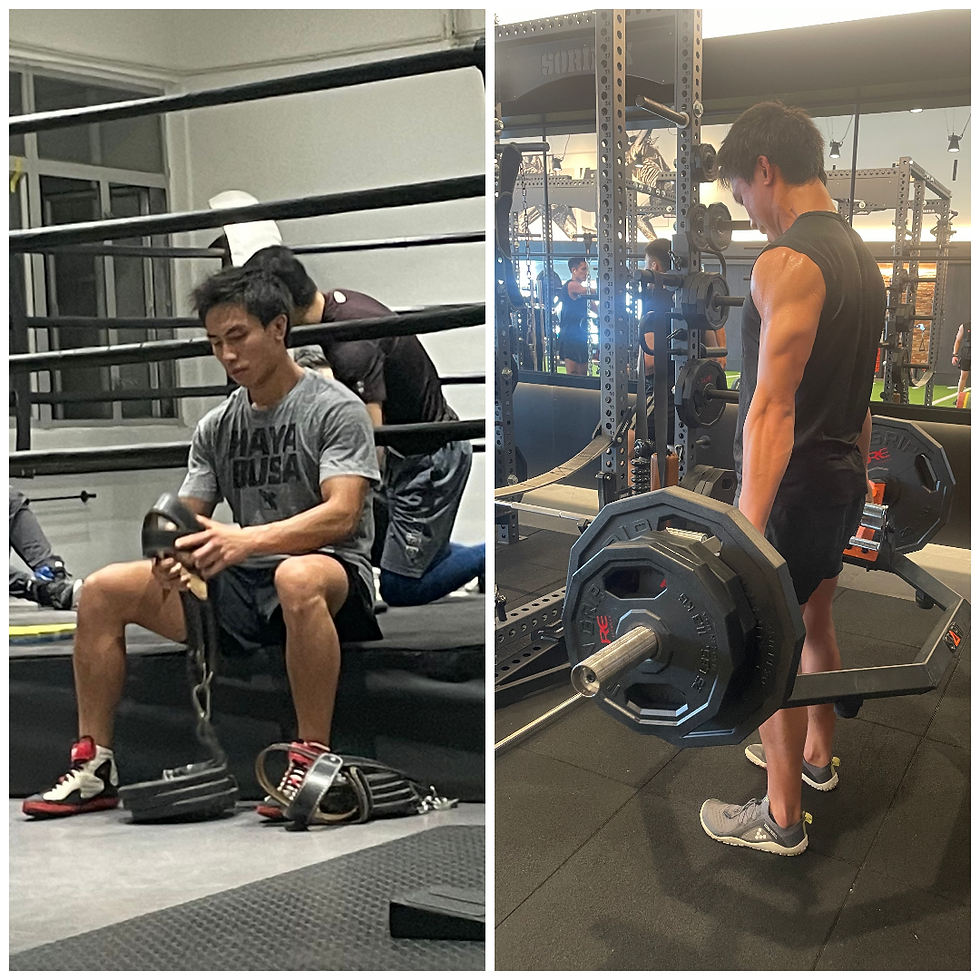
Boxing Made Fitness Fun Again
Eventually, boxing became much more than something I personally enjoyed.
When I became a Personal Trainer and Boxing Coach at PURE Fitness, I started incorporating it heavily into my coaching.
One of the most common goals clients came to me with was:
Fat loss.
And many thought the solution had to be endless cardio.
Treadmill.
Bike.
Elliptical.
Repeat.
There's nothing wrong with those tools.
But there's one major problem with any exercise programme:
It only works if you keep doing it.
Boxing offered something completely different.
Instead of telling someone to exercise for an hour, I could teach them a skill.
First the jab.
Then the cross.
Then footwork.
Then combinations.
Then defence.
Suddenly, they weren't staring at a treadmill timer waiting for the session to finish.
They were trying to get better at something.

You Forget You're Doing Cardio
This is probably one of my favourite things about boxing.
You're concentrating so much on the task that you sometimes forget how physically demanding it is.
You're thinking:
Move your feet.
Hands up.
Turn the hip.
Slip.
Counter.
Then the round finishes and you're completely exhausted.
Boxing can place substantial demands on both the aerobic and anaerobic energy systems. Research examining combat sports and boxing consistently describes the sport as high-intensity intermittent activity, where athletes repeatedly produce explosive efforts while recovering between exchanges and rounds.
That gives boxing a very interesting mixture of:
Cardiovascular fitness. Power. Coordination. Speed. Agility. Muscular endurance.
But there's another benefit that I think matters just as much.
You're exercising while learning.
And for many people, that's what makes it sustainable.

Consistency Beats the "Perfect" Workout
I've always believed one of the hardest parts of fitness isn't knowing what exercises to do.
It's showing up consistently enough for them to work.
You can design the most scientifically perfect fat-loss programme imaginable.
But if someone hates it, how long are they realistically going to follow it?
That's where boxing became one of my favourite coaching tools.
Clients wanted to come back because there was always another skill to learn.
A new combination.
Better footwork.
Cleaner technique.
Faster reactions.
Suddenly, progress wasn't only:
"How much weight did I lose this week?"
Progress could also mean:
"I finally landed that combination properly."
That shift matters.
Because once someone genuinely enjoys training, consistency becomes much easier.
And consistent training almost always beats the theoretically perfect programme that you quit after three weeks.
Boxing Isn't About Becoming Aggressive
This is probably the biggest misconception I hear.
People see boxing and immediately think:
Fighting. Violence. Getting punched in the face.
But you don't need to compete.
You don't even need to spar.
Some of the biggest benefits of learning boxing happen long before you ever step into a ring.
You learn patience.
You learn discipline.
You learn coordination.
You learn how to remain composed when you're tired.
And if you eventually do controlled sparring, you learn something else very quickly:
Panicking doesn't help.
When someone is standing in front of you applying pressure, becoming tense and throwing everything as hard as possible usually makes the situation worse.
You have to breathe.
Think.
React.
Stay composed.
Those lessons extend far beyond boxing.

Boxing Changed My Confidence Too
I've competed in boxing myself, and I think there's a particular type of confidence that comes from combat sports.
Not arrogance.
And definitely not believing you can beat everyone up.
Almost the opposite.
The more you learn, the more you realise how much there is still to learn.
But knowing that you can move, defend yourself, stay calm under pressure and physically handle difficult situations gives you a different relationship with your body.
You feel capable.
That's the word I keep coming back to throughout MAN Academy.
Because I don't just want training to make someone look fitter.
I want it to change what they believe they're capable of doing.
Boxing did exactly that for me.
Why Boxing Still Has a Place in How I Train
My training has evolved enormously since that first bodybuilding competition.
I've gone through phases of strength training.
Running.
HYROX.
Yoga and mobility.
But boxing has stayed.
Because it gives me something those other disciplines don't.
Strength training teaches me to produce force.
Running develops endurance.
Yoga helps me understand movement, mobility and control.
HYROX challenges my ability to keep performing under fatigue.
Boxing forces me to put movement, fitness, coordination and decision-making together in real time.
You can't completely switch your brain off.
Someone or something is always giving you information that you have to respond to.
And I think that's incredibly valuable.

Final Thoughts
Looking back, it's funny that I originally walked into a boxing gym because I wanted to burn more calories for a bodybuilding competition.
I thought I was adding cardio.
Instead, I discovered an entirely new way of using my body.
Boxing taught me that having muscle and being physically capable aren't necessarily the same thing.
It taught me to coordinate my body.
To move.
To react.
To stay composed while tired.
And eventually, it became an important part of how I coach other people too.
I don't believe everyone needs to become a fighter.
I don't believe everyone needs to spar.
And I certainly don't believe everyone needs to compete.
But I do believe almost anyone can gain something from learning how to box.
Fitness is one benefit.
Confidence is another.
But perhaps the biggest benefit is discovering that your body can do far more than simply lift weights or run on a treadmill.


Comments