Are You Eating Enough to Actually Perform?

Updated: Aug 31

I wasn't a sporty kid growing up.
In fact, I was pretty chubby.
That started changing when I moved to the UK for boarding school at the age of 10.
Suddenly, sport was everywhere — rugby, cross-country, swimming, gym sessions and constantly running around outside.
Year by year, I got leaner.
The funny thing?
I wasn't dieting.
Boarding-school meals were basically a buffet every day — which, strangely, I loved. I ate a ton of food. And that doesn't even include the pizzas and Chinese takeaways we'd order on top of it.
I was eating more, moving more and getting into better shape.
But as I got leaner, something changed.
Looking lean became an obsession.
When Being Lean Became the Goal
I went to a co-ed secondary school. We were teenagers. Of course we wanted to impress the opposite sex.
I remember walking past the Abercrombie & Fitch flagship store in London and seeing topless male models with six-packs.
Then Twilight came along.
When Taylor Lautner took his shirt off and every girl in the cinema screamed, my teenage brain reached a very scientific conclusion:
I need abs.

That obsession eventually kick-started my bodybuilding journey.
But it also made me increasingly restrictive with food.
I'd diet hard for a few days, become absolutely starving, then binge.
Restrict. Binge. Repeat.
And unsurprisingly, I felt terrible.
At the time, bodybuilding websites and YouTube constantly told us:
Want to lose body fat? You need a calorie deficit.
Technically, that's true.
But aggressively applying adult fat-loss strategies to a growing teenage athlete is where things can go very wrong.
Teenagers Aren't Small Adults
A teenager isn't only eating to fuel a workout.
You're fuelling:
Growth. Puberty. Your brain. School. Sport. Recovery. Bone development. Muscle development.
Then you're asking your body to perform on top of all of that.
Sports scientists use the term low energy availability when the body isn't receiving enough energy to adequately support both exercise and normal physiological functions.
When this becomes prolonged and problematic, it can contribute to Relative Energy Deficiency in Sport (RED-S).
And this doesn't only affect female athletes.
Male athletes can experience it too.
Research has linked problematic low energy availability with impaired recovery, bone health, hormonal function, immunity and athletic performance.
So if you're deliberately starving yourself because you think becoming lighter will make you a better athlete, you could eventually achieve the exact opposite.
Eating More Actually Made Me Better
Thankfully, boarding school kept me ridiculously active.
A normal afternoon could look something like:
2–4pm: Rugby
4–5pm: Gym
5–6pm: Swimming
And sometimes we'd still go back outside at 9pm for touch rugby, running or whatever else we could find to do.
I loved it.
Eventually, I stopped obsessing over dieting and just ate.

Most of my food was simple:
Protein. Carbohydrates. Fats. Fruit. Vegetables.
And yes — pizza and Chinese takeaway sometimes too.
Something interesting happened.
I had more energy.
I trained harder.
I recovered better.
I built more muscle.
And I still stayed lean.
Years later, when I became a coach and learned more about sports nutrition, it made sense.
I hadn't discovered some magical metabolism hack.
I had simply stopped trying to under-fuel a body that was growing and training for hours every day.
Protein Isn't Enough
This is something I see in young athletes today.
They understand:
Protein = muscle.
That's great.
But then some become so obsessed with protein and staying lean that they'll eat chicken, eggs and protein shakes while becoming scared of carbohydrates or simply not eating enough total food.
That's a mistake.
Protein provides the building blocks needed for growth and repair.
But carbohydrates are also an important fuel source for high-intensity exercise and sport.
Think about football, rugby, squash, boxing, sprinting or a demanding strength & conditioning session.
You need fuel to perform those activities properly.
Dietary fats matter too, providing essential fatty acids and helping with the absorption of fat-soluble vitamins.
Young athletes shouldn't be thinking:
"How little can I eat while still performing?"
A much better question is:
"How well can I fuel my body so I can perform?"

Being Lean Doesn't Mean You're Athletic
This is probably the biggest message I want young athletes to understand.
Social media makes being extremely lean look synonymous with being fit.
It isn't.
Visible abs don't tell me how fast you are.
They don't tell me how strong you are.
They don't tell me how well you recover.
And they certainly don't tell me whether you're healthy.
Being lighter can benefit certain athletes in certain situations, but constantly chasing lower body fat during adolescence can compromise the very qualities you're trying to develop.
Strength. Power. Speed. Muscle. Recovery. Bone health.
Research into RED-S also highlights how pressure around appearance and the so-called "athletic look" can contribute to problematic eating behaviours and inadequate energy intake.
At 15, I'd much rather see an athlete becoming stronger, faster and more capable than obsessing over whether their lower abs are visible.
What I'd Tell a Young Athlete Today
If I could go back and speak to myself at 15, I wouldn’t start by talking about supplements, calories or how lean I wanted to be.
I’d start with the basics.
If you’re asking your body to train, compete, recover, study and grow at the same time, you have to give it enough fuel to do all of those things.
This is the hierarchy I wish I had understood much earlier:
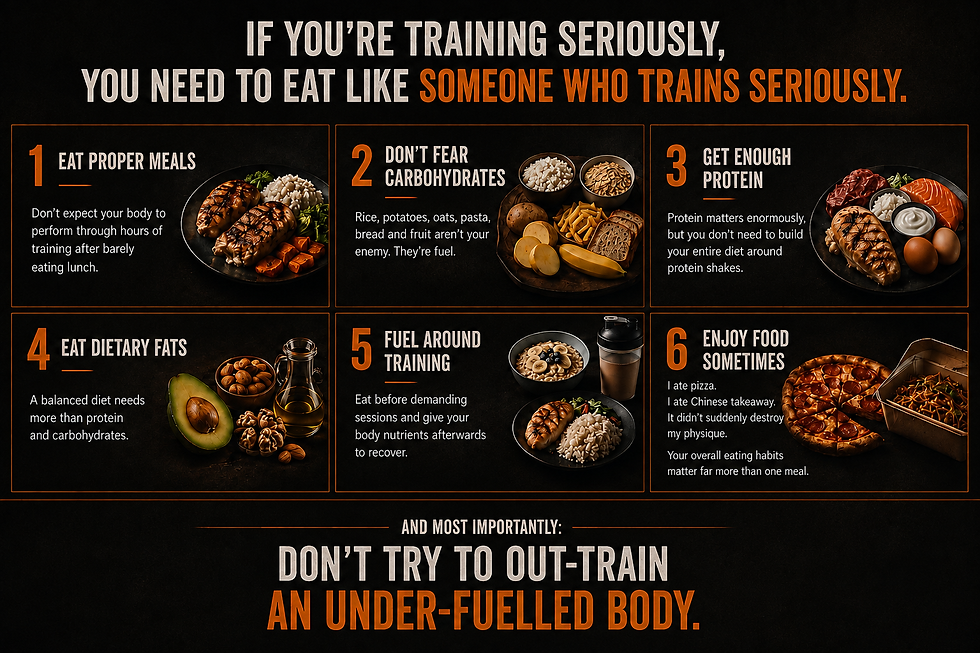
I wouldn't tell myself to stop caring about looking good.
I'd be lying.
Wanting to improve my physique was one of the reasons I fell in love with training in the first place.
But I'd change the question.
Instead of asking:
"How little can I eat to get lean?"
I'd ask:
"How well can I fuel myself to become stronger, faster and more muscular?"
Because ironically, when I stopped obsessing over eating less and focused on training hard and eating properly, my physique improved anyway.
More importantly, so did my performance.
Eat to Build the Athlete
If you're 14, 15 or 16 and training seriously, this probably isn't the time to become obsessed with shrinking yourself.
You're going through one of the most important periods of physical development you'll ever experience.
Use it.
Build muscle.
Build strong bones.
Develop speed.
Learn skills.
Recover.
Sleep.
And give your body enough energy to do all of it.
If you're constantly exhausted, losing significant weight, frequently injured, struggling to recover or becoming afraid of eating or gaining weight, speak to your parents and an appropriately qualified healthcare or sports-nutrition professional.
Getting leaner doesn't automatically make you a better athlete.
Sometimes the breakthrough isn't another workout.
It isn't another diet.
SOMETIMES YOU SIMPLY NEED TO EAT ENOUGH TO BECOME THE ATHLETE YOU'RE TRYING TO BUILD.


Comments