How HYROX Completely Changed the Way I Train

Updated: Aug 22
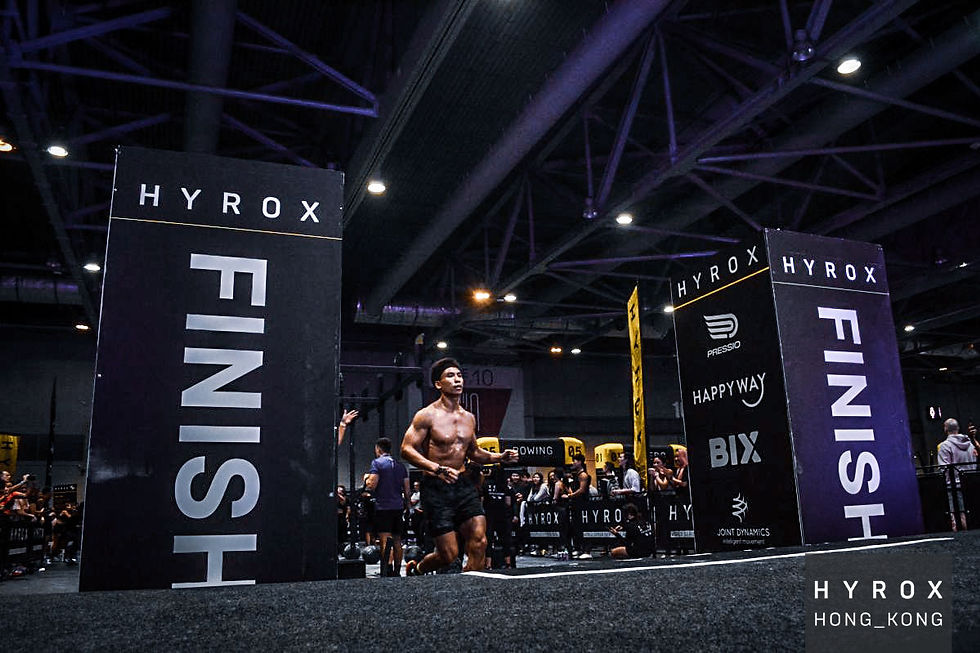
The race I felt like I'd been preparing for long before I even knew it existed.
Why HYROX Immediately Caught My Attention
I've always had a slightly complicated relationship with fitness.
I love lifting weights.
But I also love running.
Growing up in the UK, I competed in cross-country and found that I was naturally quite good at middle and longer-distance running. At the same time, I spent countless hours in the gym trying to build muscle and become stronger.
As I got older, those two worlds seemed increasingly separate.
If I focused heavily on bodybuilding, my running suffered.
If I ran too much, I worried about losing muscle and strength.
And when I eventually became interested in powerlifting, I realised something else:
I wasn't strong enough to compete with serious powerlifters, and I wasn't fast enough to compete with serious runners.
Then I discovered HYROX.
Eight 1km runs.
Eight functional workout stations.
SkiErg. Sled push. Sled pull. Burpee broad jumps. Rowing. Farmers carry. Sandbag lunges. Wall balls.
I remember looking at the format and thinking:
This is exactly what I've been looking for.
For the first time, being reasonably good at lots of things wasn't a weakness.
It was the entire point.

I Didn't Want to Choose Between Strength and Endurance
For years, gym culture made it feel like you had to choose.
Do you want to be muscular?
Strong?
Or do you want to be good at endurance?
There is some science behind why combining the two requires intelligent programming.
Researchers have studied what's known as the concurrent training effect for decades — the idea that simultaneously training strength and endurance can sometimes interfere with certain adaptations if volume, recovery and programming aren't managed properly.
But that doesn't mean you can't develop both.
Modern research suggests concurrent strength and endurance training can still produce substantial improvements in both qualities, particularly when training is programmed appropriately.
And for most of us, that's far more relevant than maximising one quality at the expense of everything else.
I'm not trying to become the world's strongest man.
I'm not trying to run a world-class marathon.
I want both.
HYROX finally gave me a sport where that mentality made sense.

A Competition Built Around Simple Movements
Another reason HYROX immediately appealed to me was its simplicity.
Compare it with something like CrossFit.
There are no handstand walks.
No Olympic lifts.
No complex gymnastics skills.
And unlike obstacle racing, I'm not climbing ropes or crawling through mud.
HYROX is largely built around movements most people can understand relatively quickly.
Run. Push. Pull. Carry. Lunge. Jump. Throw.
Simple doesn't mean easy.
Try pushing a heavy sled after running.
Or doing 100 wall balls when your legs are already exhausted.
That's where HYROX becomes interesting.
The challenge isn't necessarily learning an incredibly complicated movement.
It's whether you can continue performing basic movements well while fatigued.
And that's a very different type of fitness.

It Completely Changed My Training Habits
Once I started preparing for HYROX, my training changed almost immediately.
Running had purpose again.
I wasn't just jumping on a treadmill because I thought I should "do some cardio."
Every kilometre contributed towards something.
I also started doing movements I'd historically avoided.
Burpees were probably the biggest one.
Like most people, I hated them.
Then suddenly I had to become good at them.
Leg training changed too.
There was no skipping legs because I wanted to train upper body again.
Running, sled pushes, sled pulls, lunges and wall balls all punish weak legs.
I developed a particular love-hate relationship with wall balls.
They're incredibly simple.
Until you're exhausted.
Then suddenly squatting, throwing, catching and breathing at the same time becomes a psychological battle.
HYROX made me appreciate exercises not because of how they made a particular muscle look, but because of what they allowed my body to do.
Even the Way I Look at a Gym Changed
This still makes me laugh.
Years ago, I'd walk into a gym and look at the bodybuilding equipment.
What chest machines do they have?
What cable stations?
How many benches?
Now I walk in and think:
Where's the sled?
Do they have a SkiErg?
Is there a RowErg?
Is there enough space to carry something?
My definition of a good gym completely changed because my definition of fitness changed.
I stopped judging training purely by muscle size or how much weight I could move once.
I became more interested in work capacity — how much quality physical work can I repeatedly perform?
That's much closer to how I want my body to function in real life.

Training Under Fatigue Is a Skill
This is another thing HYROX taught me.
Running 1km on fresh legs isn't particularly complicated.
Doing lunges when you're fresh isn't particularly complicated either.
But run after pushing and pulling a heavy sled, then try settling back into an efficient running pace.
Everything feels different.
Your heart rate is elevated.
Your breathing is harder.
Your legs are heavy.
Your technique starts trying to fall apart.
Research around fatigue and endurance performance consistently shows that fatigue can affect movement mechanics, neuromuscular performance and our perception of effort.
That's why HYROX isn't simply:
Running + exercises.
You're repeatedly being asked to produce useful movement while carrying fatigue from the previous station.
Learning to control that is part of the sport.
And I think there's something valuable about developing that ability even outside HYROX.
HYROX Gave Training a Purpose Again
This might actually be the biggest benefit.
I've coached plenty of people who say:
"I just want to get fitter."
The problem is that "get fitter" has no finish line.
It's incredibly easy to skip today's run.
There's always tomorrow.
Signing up for an event changes that.
Suddenly there's a date on the calendar.
You've paid the entry fee.
The race is coming whether you're ready or not.
Behavioural research around goal setting consistently supports the value of having
specific, challenging goals rather than vague intentions.
I've seen this in myself and in other people.
Once there's a HYROX on the calendar, suddenly that Saturday run matters.
You practise your burpees.
You stop avoiding lunges.
You start thinking about recovery.
You're no longer simply exercising.
You're preparing for something.

It Also Changed the Way I Coach
Eventually, HYROX became more than something I personally enjoyed.
I started seeing how useful elements of this style of training could be for other people.
During my time at ESF King George V School, I even introduced HYROX-style training into the PE programme.
Not because every student needed to become a HYROX competitor.
But because the format gives people exposure to so many fundamental physical qualities.
Running.
Strength.
Conditioning.
Coordination.
Pacing.
Resilience.
And most importantly, it can make fitness feel like a challenge rather than a chore.
That idea became important to the way I think about MAN Academy too.
Training should prepare you for something.
Even if that something is simply becoming a more capable version of yourself.

HYROX Isn't Perfect
I don't think everyone needs to race HYROX.
And I definitely don't think HYROX should be your entire training programme.
There are qualities it doesn't develop particularly well.
Maximum strength.
Mobility.
Rotation.
Upper-body power.
Complex movement skills.
That's why HYROX is only one part of how I train today.
I still strength train.
I box.
I practise mobility and yoga.
I run.
HYROX sits somewhere in the middle and gives those different physical qualities somewhere to meet.
And perhaps that's exactly why I enjoy it so much.
Final Thoughts
Looking back, HYROX didn't simply give me another competition to enter.
It changed what I wanted from my body.
For years, I trained primarily to look muscular.
Then I became interested in becoming stronger.
Then boxing made me want to move better.
Running made me appreciate endurance again.
HYROX somehow brought many of those worlds together.
I'm never going to outlift a competitive powerlifter.
I'm never going to outrun an elite distance runner.
And that's okay.
I want to be able to lift, run, fight, move and endure.
HYROX gave me a competitive environment where being well-rounded finally felt like an advantage rather than a compromise.
And more importantly, it reminded me of something I'd gradually forgotten after years in the gym:
DON'T TRAIN TO LOOK FIT.
TRAIN TO BE CAPABLE.


Comments